
Inline enforcement
Users pass through Access Proxy first. MFA is enforced before protected application routes are reached.
MFA reverse proxy
A reverse proxy can enforce IdP-based MFA at the access layer, which makes it useful for legacy apps, custom portals, and internal tools that were not built for modern authentication.
Datawiza Access Proxy can also provide built-in MFA after the existing app login and before application access, with centralized policy and audit-ready access logs. Add MFA outside the app instead of rewriting every login flow.










The practical difference
The protected app does not need to know how MFA works. Datawiza handles the access decision before the request reaches the application server.
Users pass through Access Proxy first. MFA is enforced before protected application routes are reached.
Use Datawiza built-in MFA methods without requiring the app to integrate with an external identity provider.
Apply MFA to the whole app or step up only for sensitive paths, admin areas, or high-risk workflows.
Protect apps across data centers, private cloud, public cloud, and hybrid environments with a consistent proxy pattern.
Comparison
In-app MFA can work for modern apps that teams can change quickly. A reverse proxy model is better when speed, legacy compatibility, and low disruption matter.
| Criteria | Datawiza Access Proxy | In-App MFA |
|---|---|---|
| Where MFA runs | Datawiza enforces MFA at the reverse proxy layer before application access. | MFA runs inside each application, login controller, or authentication flow. |
| Code impact | No application source-code changes required for MFA enforcement. | Application teams must add, test, and maintain MFA logic. |
| Rollout model | Route one app through the proxy, validate policy, then expand to more apps. | Each app needs a separate implementation and release schedule. |
| Legacy apps | Strong fit for apps that lack native MFA, SAML, OIDC, or modern login patterns. | Can be difficult or risky when the app is old, vendor-managed, or poorly documented. |
| Audit | Access, MFA, and policy decisions can be captured centrally. | Audit quality depends on each app implementation. |
| Best-fit project | Fast MFA for existing web apps without changing application code. | New or heavily refactored applications where MFA belongs inside the app. |
Architecture proof
Identity provider migrations are useful when you are rebuilding identity, migrating users, or redesigning login across applications. But if the immediate goal is to add MFA to existing apps, that path can create more work than the security project needs.
Datawiza Access Proxy gives teams a faster deployment model: choose the MFA source that fits each user population, place enforcement in front of the app, keep the application unchanged, and roll out stronger access control app by app.
Good fit for new apps or broad customer identity transformation. Slower fit when the app simply needs MFA now.
Good fit for legacy apps, customer portals, partner apps, and internal tools that need MFA without code changes.
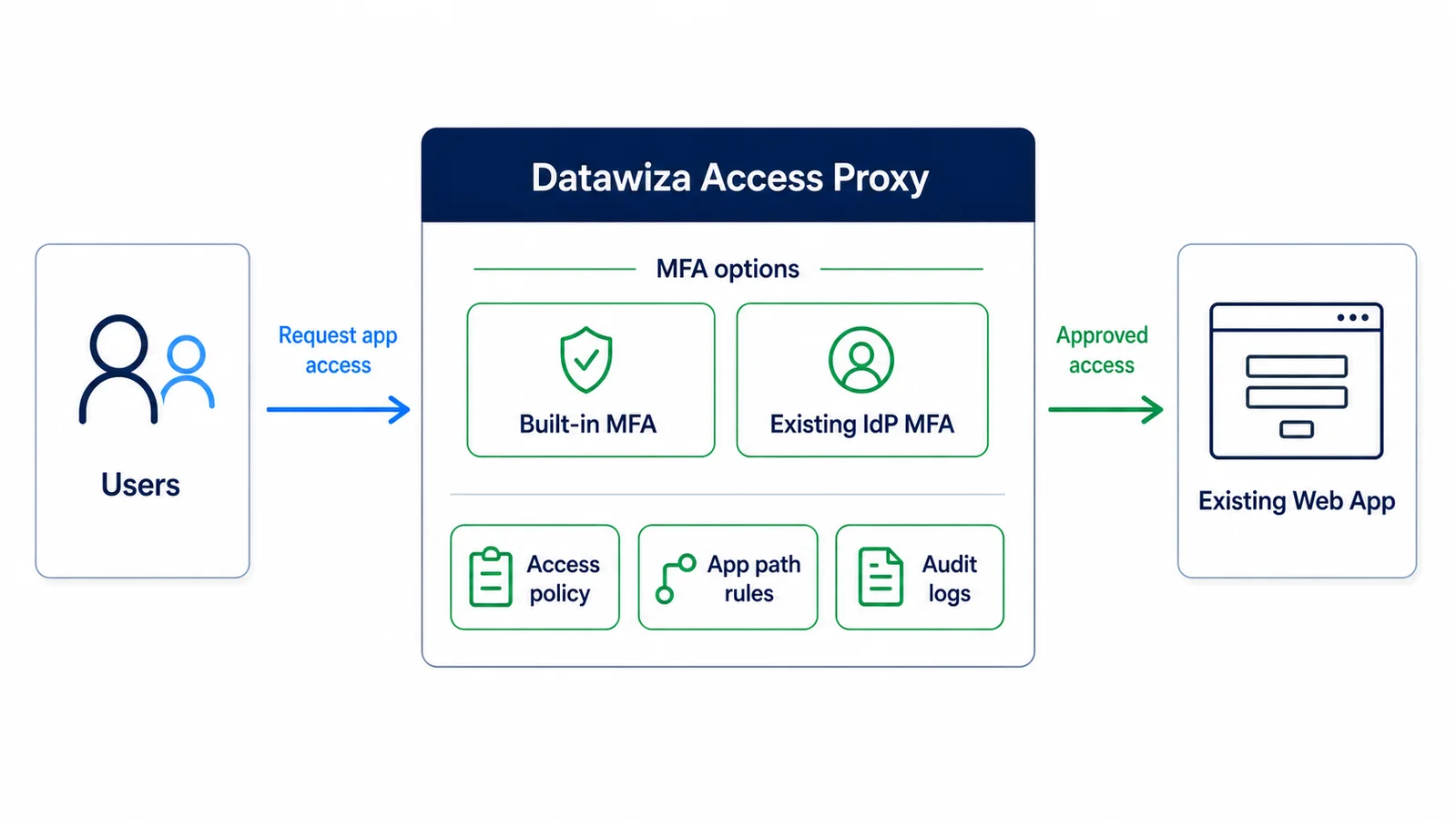
Proxy-based MFA architecture
Why teams choose this path
Deployment timeline
Start with one app, validate the policy, then repeat the same access-layer pattern across the rest of the portfolio.
Choose a high-risk customer portal, partner app, internal tool, or legacy application.
Route traffic through Datawiza Access Proxy, choose built-in MFA or your existing identity provider, and define who should be challenged, when, and for which app paths.
Validate the user experience, access logs, and rollback plan with a limited audience.
Apply the same gateway pattern to more apps without starting a new MFA coding project each time.
Customer proof
“Datawiza is the ideal solution for adding MFA to on-prem applications without the need to overhaul existing code or infrastructure.”
Related MFA use cases
Explore practical MFA patterns for customer portals, internal systems, legacy applications, ERP platforms, and other existing web apps.
Start with the main overview for built-in MFA, proxy enforcement, app coverage, and rollout strategy.
Get the definition of no-code MFA, including built-in MFA, identity provider mode, and where access-layer enforcement fits.
Protect PeopleSoft HCM, payroll, employee self-service, retiree portals, and other web-based HR systems without changing app code.
Add MFA to legacy applications without changing source code, migrating users, or waiting for an application rewrite.
Add MFA or 2FA to public-facing, external-facing, internet-facing, internal, and custom web applications without changing app code.
Add MFA to IIS applications without touching code, using Datawiza built-in MFA or Entra ID, Okta, Ping, or Duo as the identity provider.
Protect admin portals, admin dashboards, back-office apps, and privileged web consoles with MFA before app access.
Protect customer portals, partner apps, vendor portals, and customer-facing applications without forcing a CIAM migration.
How it works
Datawiza Access Proxy sits between users and protected apps. It verifies the user, enforces MFA, applies policy, then forwards approved requests to the application.
Place Datawiza Access Proxy between users and the protected web application.
Use built-in MFA and policy rules to decide when users must complete additional verification.
After authentication succeeds, Datawiza forwards approved traffic to the app.
Capture MFA, access, and policy events for audit, operations, and security review.
Use cases
FAQ
An MFA reverse proxy sits between users and a web application. It enforces MFA before forwarding approved requests to the application, so the app does not need native MFA support.
They are closely related. MFA reverse proxy describes the technical architecture. MFA gateway describes the access-control role it plays for users and applications.
Yes. Datawiza Access Proxy enforces MFA at the proxy layer, before requests reach the application, so the protected app does not need MFA code changes.
No. Datawiza includes built-in MFA. You can use Datawiza alone for this use case or connect an identity provider when your environment needs it.
No. Legacy apps are a strong fit, but the same reverse proxy pattern can protect customer portals, partner apps, internal tools, and modern apps where centralized MFA policy is useful.
Next step
Bring one customer portal, B2B app, internal tool, or legacy web application. Datawiza can show where Access Proxy sits, how MFA is enforced, and what changes are avoided.