
Identity gap
Agent actions are often logged under shared or service identities, making it difficult to identify both the responsible user and the acting agent.
AI agent governance
Secure AI agent access across APIs, MCP, and A2A with identity-aware controls, data loss prevention (DLP), and PII protection. Govern tool use, inspect requests and responses, protect credentials, and audit each action.










Governance Gap
AI agents can search enterprise data, call APIs, invoke MCP tools, update SaaS applications, trigger workflows, and delegate tasks to other agents. In many enterprises, these access paths still rely on direct endpoints, broad tokens, shared credentials, and inconsistent controls.
Agent actions are often logged under shared or service identities, making it difficult to identify both the responsible user and the acting agent.
Agents need controls over both the actions they take and the PII, credentials, and confidential data those actions can expose.
Logs are fragmented across agents, MCP servers, APIs, SaaS applications, and downstream systems, making investigations and access reviews difficult.
Agent Gateway
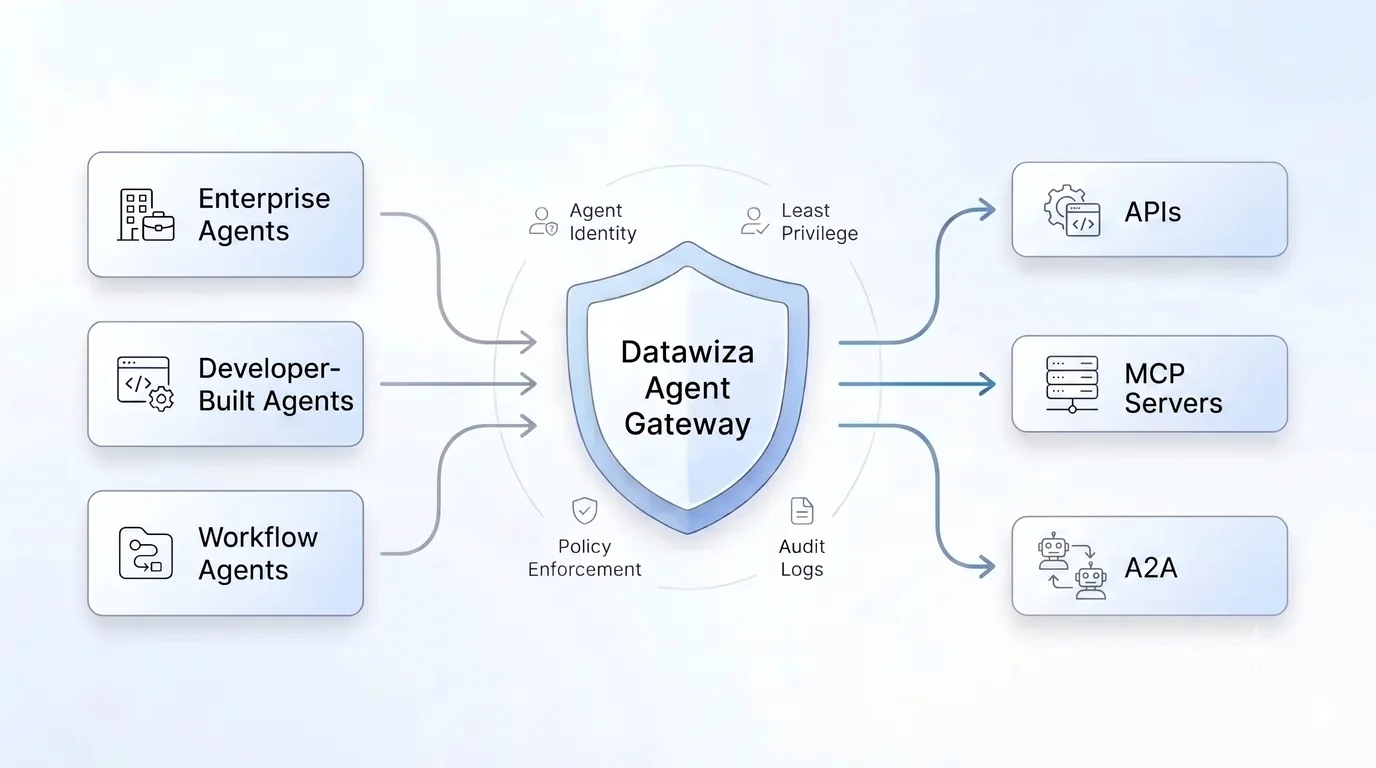
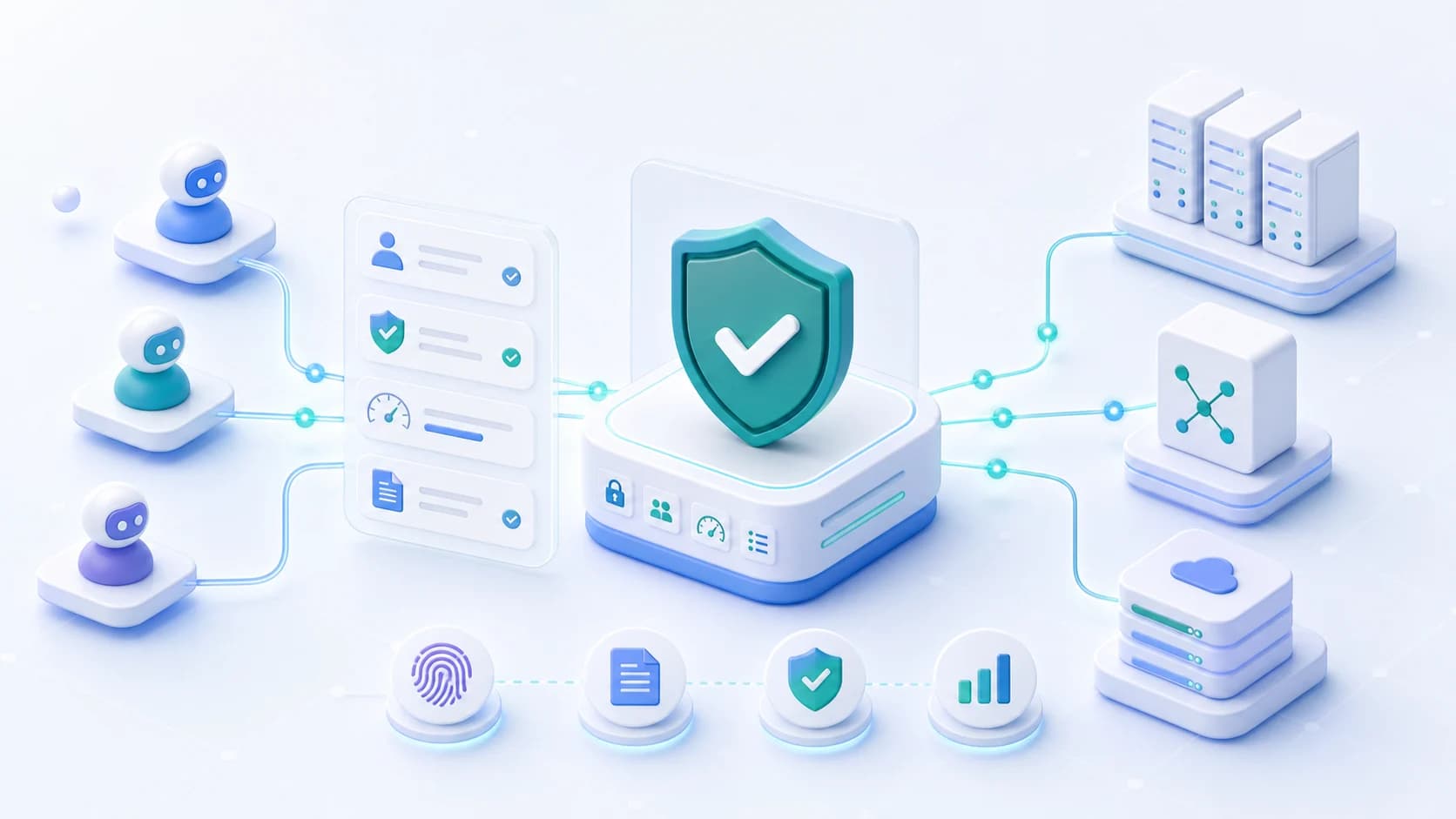
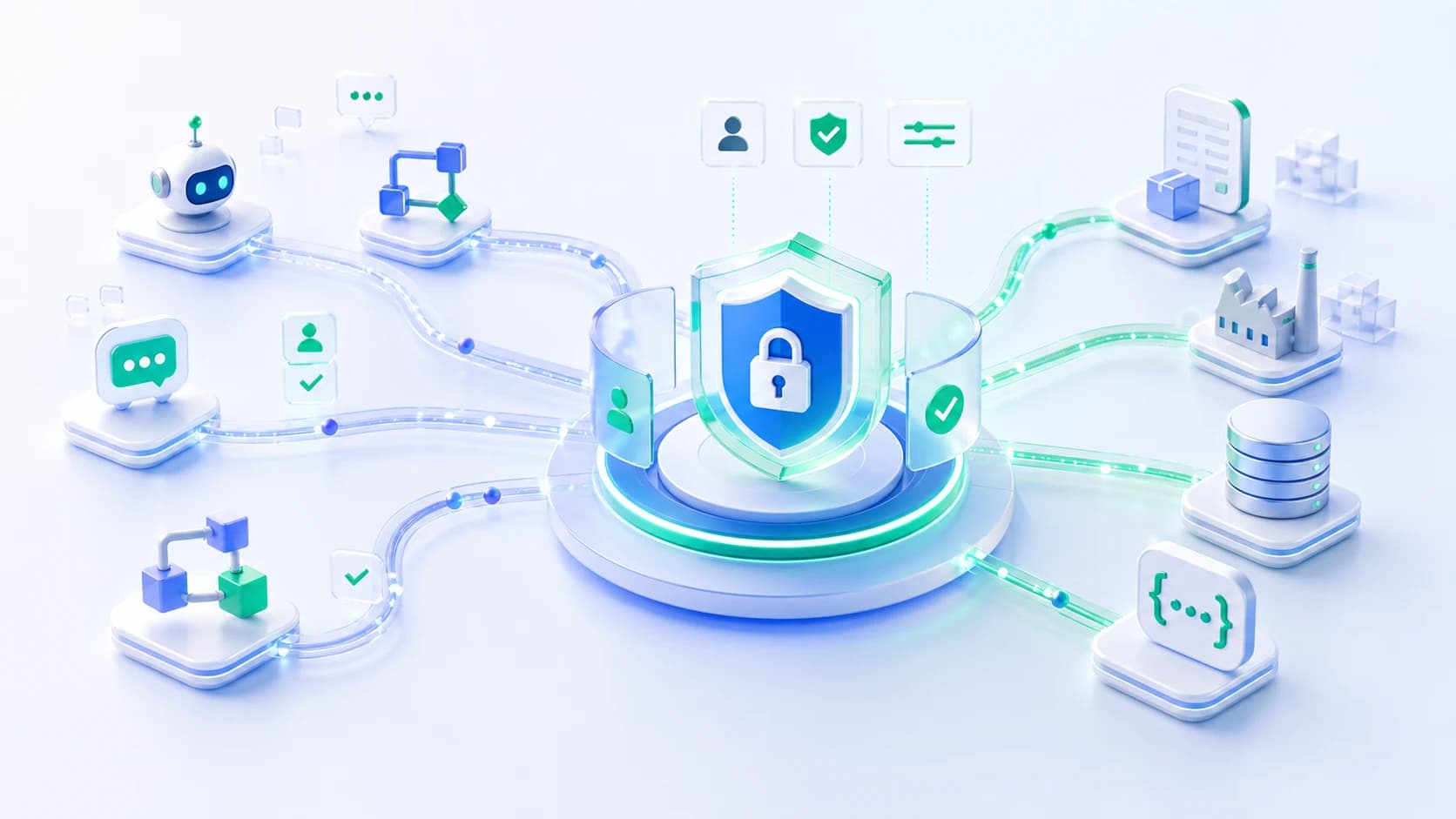
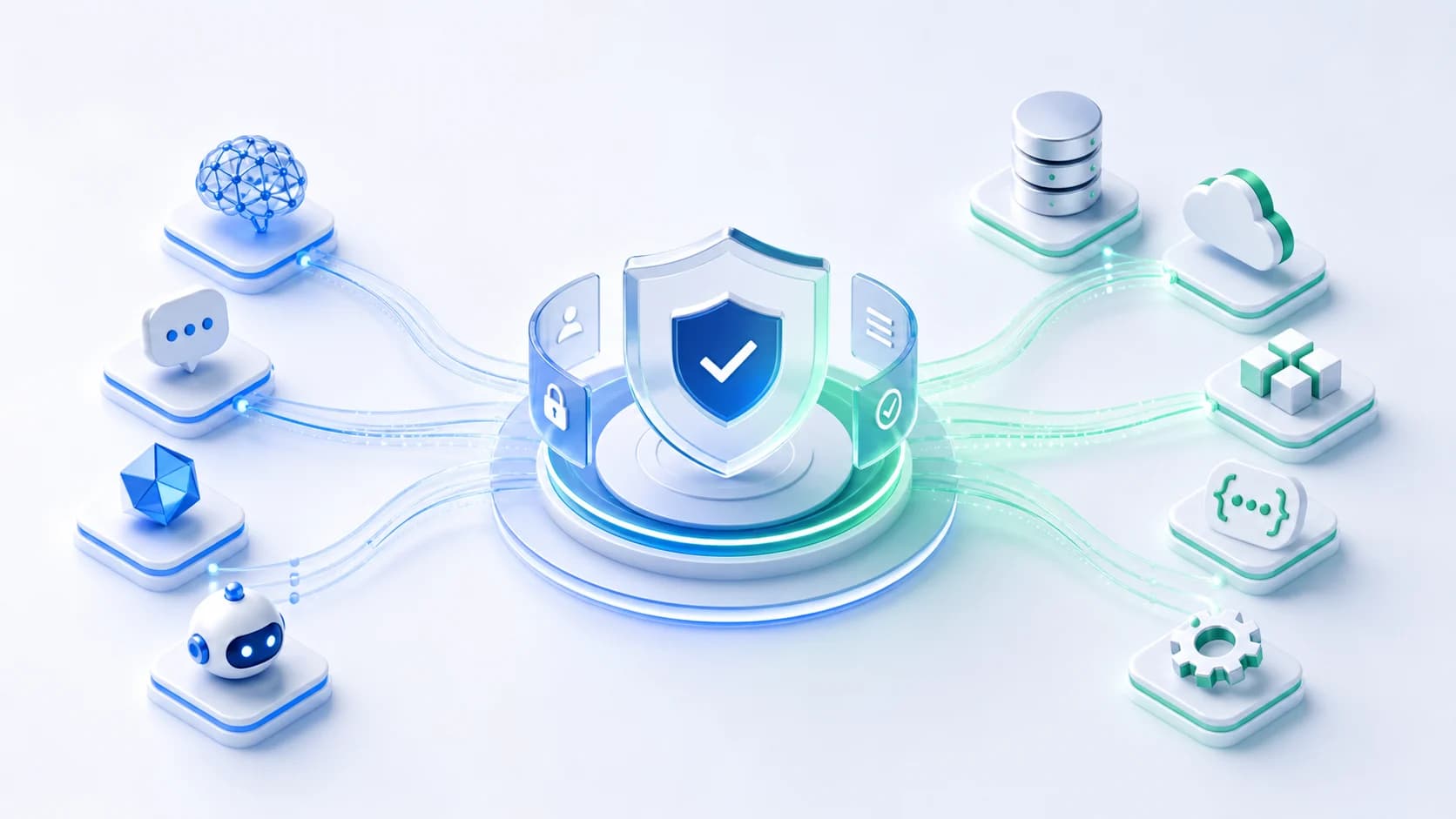
An Agent Gateway is the runtime enforcement layer between AI agents and the tools, enterprise systems, or other agents they access through APIs, MCP, or A2A. Datawiza combines identity and action policies with DLP and PII protection to govern both agent access and the data exchanged in agent workflows. Verify the user and agent, authorize the action, inspect sensitive content, broker the approved credential, and record the outcome.
Decide which users and agents can reach which tools, systems, resources, actions, and other agents based on identity, delegation, and runtime context.
Apply data loss prevention (DLP) to agent requests and tool results. Detect PII, credentials, and confidential data, then block or redact sensitive content according to policy.
Exchange, retrieve, or inject the approved downstream credential at runtime without exposing backend tokens, API keys, or legacy secrets to the agent.
Record the initiating user, acting agent, target, requested action, policy decision, credential event, approval state, and outcome.
Workflow
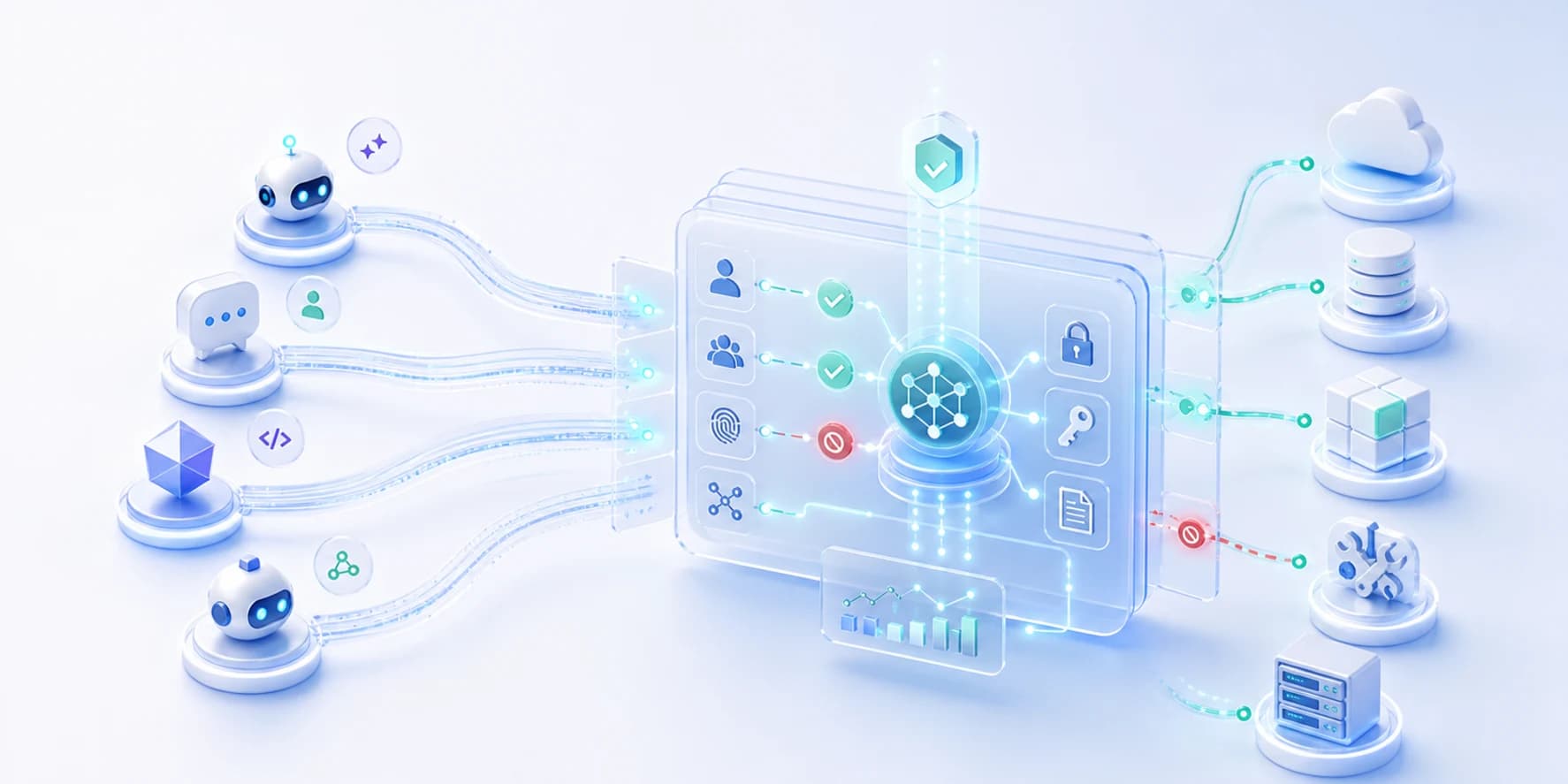
Route agent traffic through Datawiza to enforce identity, access, and data-protection policies in one workflow. Inspect outgoing requests and returned content, broker credentials, and record what each agent does.
Runtime Controls
Treat every agent action as a new authorization decision. Validate both the real user and the acting agent using identity context from Microsoft Entra ID, Okta, Ping Identity, AWS IAM through OIDC federation, or another standard OIDC or SAML provider.
Control access at the MCP server, tool, action, API endpoint, method, SaaS operation, business resource, target agent, or A2A skill level.
Support federated token exchange, OAuth token management, and vaulted credentials for SaaS, cloud-native, internal, and legacy systems.
Require approval for bulk exports, destructive changes, and privileged operations. Apply per-user and per-agent limits to contain excessive data access and runaway activity.
Inspect requests and tool responses for PII, credentials, and sensitive data. Block or redact matched content according to your data-protection policies.
Capture user, agent, target, access and DLP decisions, credential events, approval state, and outcome for security and operational review.
Sensitive data protection
Apply data loss prevention (DLP) to the content agents send and receive. Detect PII, credentials, and sensitive business data, then block or redact matched content according to policy before it reaches a tool or returns to an agent.
Identify personally identifiable information (PII), API keys, tokens, and other sensitive data in agent requests and tool results.
Block disallowed transfers or mask matched values so approved workflows can continue with sensitive content removed.
Apply data-protection rules to agent traffic and record detections and enforcement decisions with user, agent, and tool context for review.
Coverage
Apply one identity, policy, credential, and audit model across agent access paths. Whether an agent invokes an MCP tool, calls an enterprise API, updates a SaaS application, or delegates work to another agent through A2A, the request passes through the same runtime governance layer.
Govern internal and SaaS-hosted MCP servers at the server, tool, action, resource, identity, and environment level.
Control agent access to REST APIs, internal HTTP services, partner endpoints, automation services, and custom business systems.
Govern agent actions in Microsoft 365, SharePoint, Salesforce, ServiceNow, Jira, GitHub, ERP, CRM, HCM, data platforms, and other enterprise applications.
Decide which agents may communicate, which skills or tasks they may invoke, what authority may be delegated, and whether the handoff requires approval.
Built for teams
Centralize access and DLP policies, reduce exposure of PII and credentials, and investigate data-protection events with the user and agent context attached.
Extend existing enterprise identity into agent workflows and apply consistent policy without building custom authorization into every MCP server, agent, and API integration.
Move AI agent workflows into production with clear controls, deployment choices, auditability, and accountability.
Deployment
Deploy the gateway close to the agents and protected systems while maintaining a consistent identity, policy, credential, and audit model across cloud, hybrid, and on-premises environments.
Keep traffic and control points inside your datacenter, private network, or segmented environment.
Run in your own AWS, Azure, GCP, or private cloud environment close to the agents, tools, MCP servers, or internal APIs you need to govern.
Adopt quickly with a managed deployment option from Datawiza.
Identity and procurement
Datawiza works with Microsoft Entra ID, Okta, Ping Identity, Auth0, AWS IAM through OIDC federation, and standard OIDC or SAML identity providers. Extend the identity foundation you already operate into AI agent access decisions.
Use your existing enterprise identity provider instead of adopting a gateway tied to one identity stack.
View integrationsPurchase and deploy through supported cloud marketplaces and channel partners when required by your procurement process.
View partnersApply one policy model across cloud, hybrid, and on-premises agent workflows without forcing a single deployment pattern.
Use cases
Combine enterprise identity and tool authorization with DLP for MCP arguments and results, credential protection, usage limits, approvals, and audit.
Explore MCP GatewayAuthorize access to approved invoices, orders, and customer records. Redact sensitive fields according to policy and restrict bulk exports, financial actions, and administrative changes.
See ERP agent accessRestrict agent access by site, library, folder, resource, tool, and action instead of giving the agent every permission available to the signed-in user.
Allow approved endpoints and methods, deny dangerous operations, protect backend credentials, and attribute usage to the responsible user and agent.
Explore access controlLet agents investigate logs and tickets while masking exposed tokens and credentials according to policy. Require approval for production changes, destructive actions, and privileged operations.
Govern which agents may delegate tasks through A2A, which skills the receiving agent may use, how user authority is propagated, and whether additional delegation is allowed.
MCP gateway
Use Datawiza Agent Gateway as an identity-aware MCP Gateway for centralized authentication, tool policy, DLP, PII protection, credential brokering, approvals, rate controls, and audit across MCP servers.
If your immediate project is MCP-specific, start with the MCP Gateway use case and then return here for the broader Agent Gateway architecture.
Explore MCP GatewayFor a wider policy program across APIs, SaaS applications, MCP servers, and other agents, use the AI Agent Access Control guide.
Explore AI agent access controlWhy Datawiza
Verify the user and agent, authorize requested actions, and enforce DLP policies on the data exchanged with tools and enterprise systems.
Use your existing enterprise identity provider instead of adopting a gateway tied to one identity stack.
Apply a consistent runtime governance model to agent-to-tool, agent-to-system, and agent-to-agent access.
Broker modern tokens, OAuth credentials, API keys, service credentials, and legacy access patterns across cloud, SaaS, internal, and enterprise applications.
Run Datawiza on-premises, in your cloud, or as a Datawiza-hosted service according to network, data-residency, and operational requirements.
Route supported agent connections through the gateway without adding a Datawiza SDK or rebuilding every downstream system.
Next step
Bring an agent workflow and the data it needs to access. See how identity-aware policies, DLP, PII protection, credential brokering, and audit work together across your tools and enterprise systems.
Setup guides
Protect remote MCP servers with Datawiza Agent Gateway and Microsoft Entra ID before cloud-based assistants or MCP clients can list or call tools.
FAQ
An Agent Gateway is a runtime enforcement layer between AI agents and the tools, systems, APIs, MCP servers, or other agents they access. It validates identity, enforces access and data-protection policies, brokers credentials, and records agent activity. DLP and PII controls inspect the content exchanged in agent workflows.
No. Datawiza Agent Gateway governs agent access across MCP servers, REST and HTTP APIs, SaaS applications, internal services, enterprise systems, and agent-to-agent connections using Agent2Agent (A2A).
An API Gateway primarily manages application and service API traffic. An Agent Gateway is designed for agent-mediated access and can evaluate the user behind the agent, the agent identity, delegation context, requested tool or action, downstream credential requirements, approval policy, and audit context. Enterprises may use both layers together.
An AI or LLM Gateway primarily manages model access and model traffic. An Agent Gateway governs the runtime actions agents take across tools, enterprise systems, APIs, MCP servers, and other agents. Datawiza Agent Gateway is focused on the second problem.
Yes, when the third-party agent or client allows its MCP, API, or A2A endpoint to be configured. The agent connects to the Datawiza gateway endpoint, and Datawiza applies policy before forwarding approved requests to the destination.
For agents and clients that support a configurable MCP, API, or A2A endpoint, deployment usually requires pointing the connection to the Datawiza gateway URL. No Datawiza SDK or downstream-system code changes are required. Fully managed integrations that do not expose a configurable endpoint may require a supported custom or bring-your-own connection path.
Datawiza supports federated token exchange for cloud-native services, securely managed OAuth tokens for SaaS platforms, and vaulted credentials for systems that use API keys, personal access tokens, service credentials, or legacy secrets. In these flows, the agent does not receive the downstream credential.
Datawiza supports Microsoft Entra ID, AWS IAM through OIDC federation, Okta, Ping Identity, and standard OIDC or SAML identity providers. Identity claims can be mapped to user, group, agent, application, tenant, resource, and action policy.
For A2A workflows, policy can control which agents may communicate, which skills or tasks they may invoke, what user or agent authority is delegated, whether further delegation is permitted, which credentials may be used, and which actions require approval.
Access policies determine which users and agents may reach a resource and what actions they may perform. Data loss prevention (DLP) inspects the content exchanged during those actions and blocks or redacts PII, secrets, or other sensitive data according to policy. Applying both helps reduce unauthorized access and data leaks through otherwise permitted workflows.
Yes. Request inspection checks content before it reaches a tool or downstream system. Response inspection checks returned content before it reaches the agent. Policies determine whether matched sensitive data is blocked or redacted, and detection and enforcement decisions are recorded with the user, agent, and tool context.
See the gateway use case, MCP policy pages, and agent-security guides that support production Agent Gateway rollouts.




Sign up to secure your AI agents and critical enterprise apps